
Building a free online tool is only the beginning.
You can test every button, review every instruction, and run through the process more times than you care to admit. Then someone else uses the tool and notices something you completely missed.
That is not a failure. That is how useful tools get better.
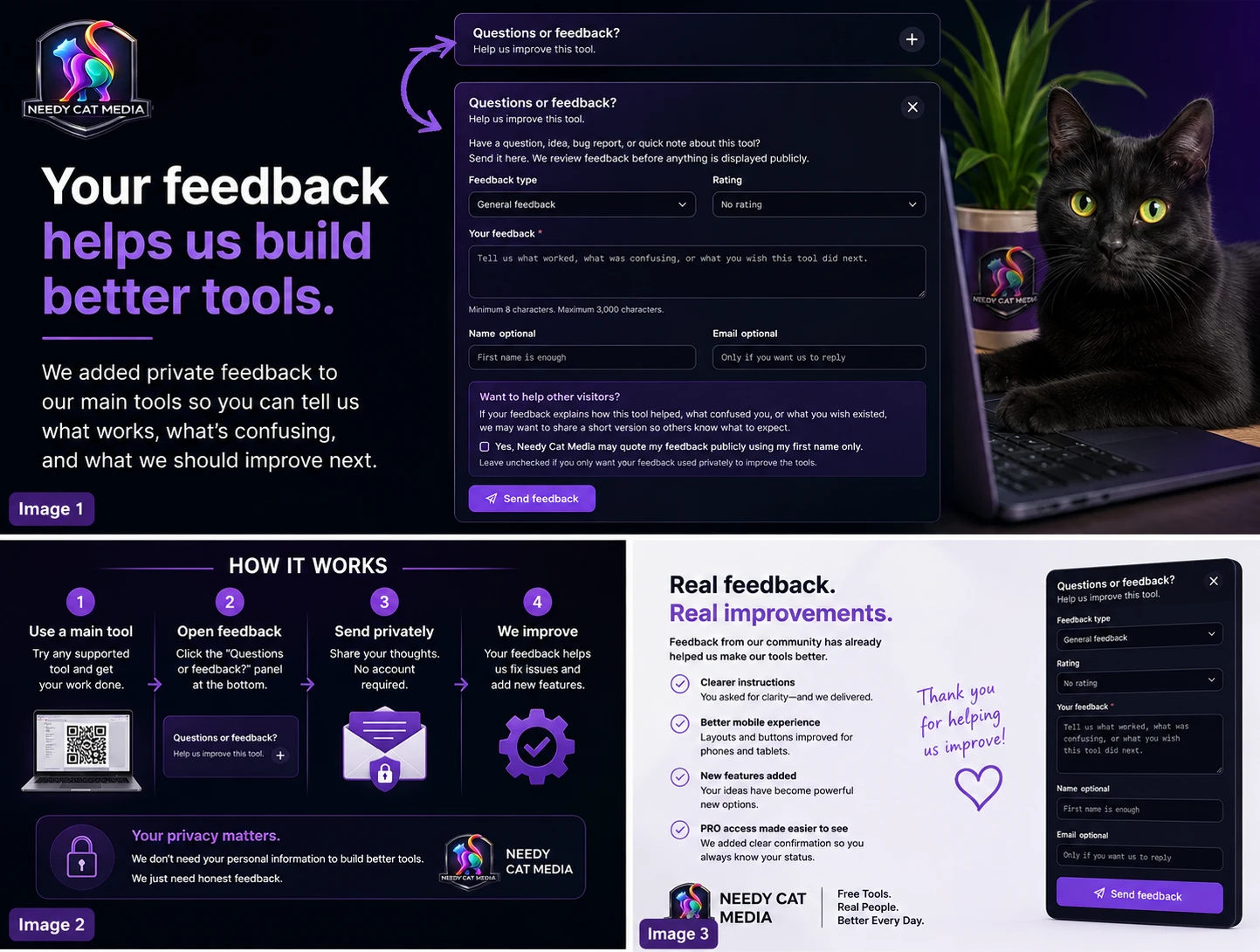
At Needy Cat Media, we recently added a private feedback option to several of our free online tools. The goal is simple: give visitors an easy way to tell us what worked, what felt confusing, and what could make the experience better.
No account. No public review. No long survey that feels like homework.
Just honest feedback from the people actually using the tools.
The idea behind it
We do not need to know everything about our visitors. We just need enough honest feedback to build better tools.
Website analytics can only tell us so much
We already track general activity across Needy Cat Media. That information helps us understand which pages people visit, which tools receive attention, and which features are being used.
Those numbers are useful, but they do not tell the whole story.
Analytics cannot always explain what someone expected to happen, which instruction was unclear, why they stopped using a tool, or whether the final result solved their problem.
A page view tells us someone arrived. A button click tells us someone took an action. Neither one tells us what that person was thinking.
That is where direct feedback becomes valuable.
We wanted feedback without creating another barrier
Many websites make visitors jump through several hoops before they can leave a comment.
Create an account. Confirm an email address. Enter a name. Complete a profile. Agree to receive updates.
By the time that process is finished, most people have forgotten what they wanted to say—or decided it was not worth the trouble.
We did not want that.
Our feedback option is designed to be quick and low-pressure. Visitors can share a thought about the tool without creating an account or signing up for anything.
We are not trying to build a collection of personal information.
Believe us, we do not want it.
We want to know whether the tool helped, whether something was confusing, and what could make it more useful. That is the information that matters.
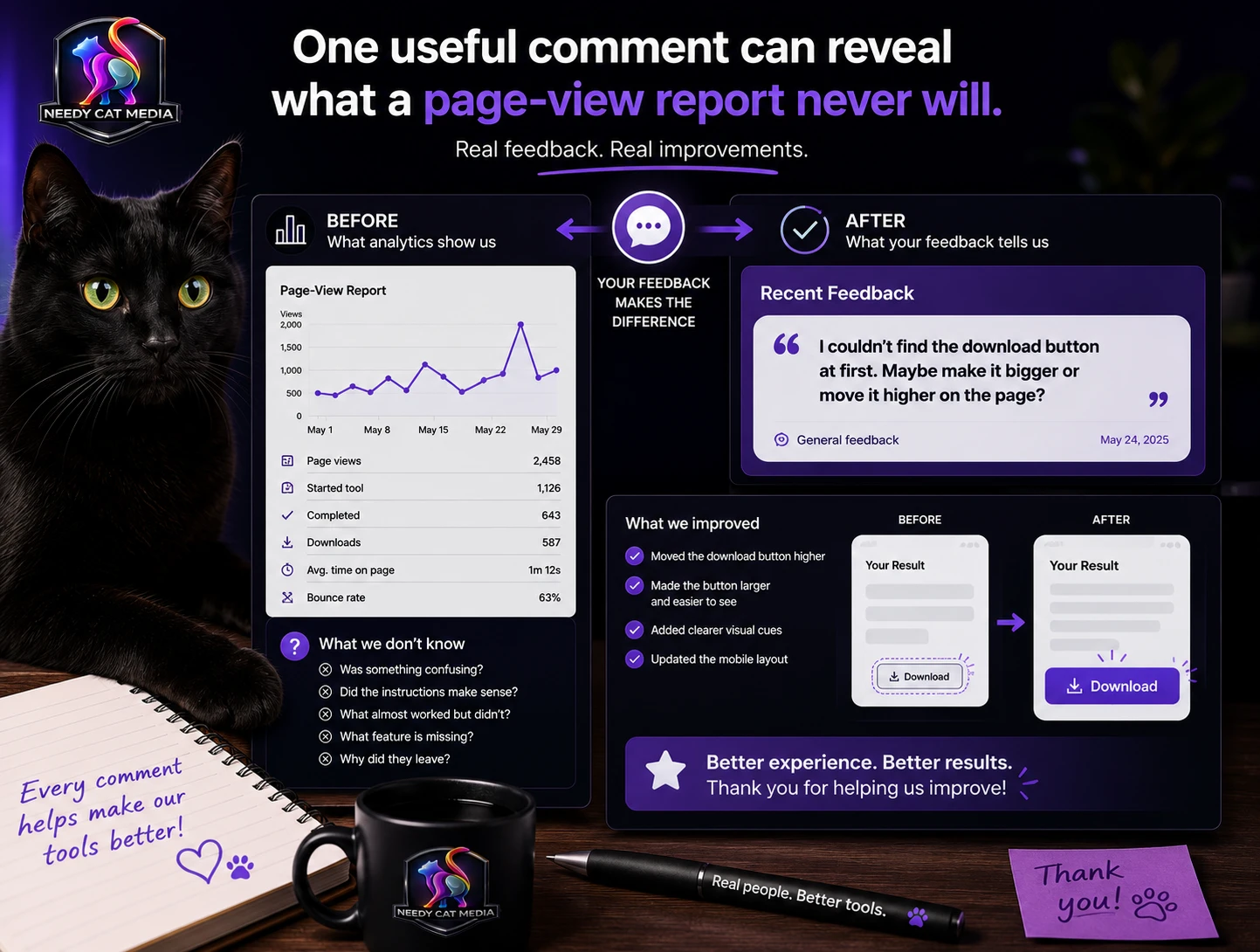
One useful comment can reveal what a page-view report never will.
Private feedback makes honest feedback easier
Not everyone wants to post a public review or attach their name to a suggestion.
Sometimes a visitor only wants to say, “I could not find the download button,” or “This worked well on my computer, but the mobile layout was difficult to use.”
Those comments may look small, but they can point directly to a problem that needs attention.
Private feedback gives people room to be honest without feeling like they are making a public announcement. It also gives us a clearer look at how the tools behave outside our own testing environment.
That matters because every visitor may be using a different device, browser, screen size, or workflow.
A tool that looks perfect on one computer can behave very differently somewhere else. Technology enjoys keeping everyone humble.
Free tools still deserve serious attention
It would be easy to publish a free tool, leave it alone, and move on to the next project.
That is not how we want Needy Cat Media to operate.
Free should not mean forgotten.
A free tool should still have clear instructions, reliable features, a professional design, and a straightforward path from beginning to end. Visitors should not have to fight with the page just because they did not pay to use it.
Feedback can help us identify where a tool needs work, including:
- Rewriting an unclear instruction
- Moving or relabeling a button
- Improving a mobile layout
- Adding a missing option
- Fixing a bug
- Making a result easier to download or print
- Explaining what happens next
- Removing something that creates unnecessary confusion
Sometimes the best improvement is a major new feature. Other times, it is changing three words on a button.
Both can make a real difference.
We are already learning from real use
Several recent improvements across Needy Cat Media came from looking closely at how people interacted with our tools.
We redesigned some of our printable forms because the original versions worked, but they did not look as polished as we wanted. The updated forms are easier to read, more professional, and still free to use and download.
We also improved the QR luggage tag builder after realizing that customers needed a clearer way to confirm when PRO access was active. The purchase process worked, but the next step was not obvious enough.
An important reminder
A feature can be technically correct and still create uncertainty. Visitors should not have to guess whether something worked.
Feedback helps us find those moments faster.
What happens when someone leaves feedback?
We review the comments and look for useful patterns.
One person may report an issue that affects only a specific browser. Several people may mention the same confusing instruction. A feature request may reveal a use case we had not considered.
Not every suggestion will become a new feature, and not every requested change will fit the purpose of the tool.
That is the honest answer.
Useful feedback can still help us:
- Prioritize updates
- Identify recurring problems
- Improve instructions
- Test overlooked devices or browsers
- Decide which tools need more attention
- Discover ideas for future tools
It gives visitors a small voice in the development process—and sometimes that small voice points directly to the next big improvement.
Privacy still matters
Many of our tools are designed to work without storing the information people enter. That privacy-first approach remains important to us.
The feedback system is not an excuse to collect unnecessary details about visitors. Its purpose is to understand the experience, not the person behind it.
We do not need someone’s full identity to learn that a button was difficult to find. We do not need a detailed user profile to learn that an instruction needs rewriting.
We need the problem, the idea, or the honest reaction.
Nothing more.
Better tools are built with people, not just for them
We can build a tool based on what we believe people need. We can test it based on how we think they will use it.
But the real answers begin appearing only after the tool reaches actual visitors.
Feedback closes the gap between what we intended to build and what people actually experience.
The goal is not to create a website where every feature is frozen in place. The goal is to keep learning, improving, and making our free tools more useful over time.
Some changes will be obvious. Others may happen quietly in the background. Either way, the people using the tools help shape what comes next.
Try a free tool—and tell us how it went.
Explore our QR, image, search-readiness, sitemap, printable, and creator tools. When you are finished, tell us what worked, what did not, or what would make the experience better.
Browse All Free ToolsTell us what you think
Your comment does not need to be long or perfectly written. A single sentence may be enough to uncover something we should improve.
We are building these tools to help real people solve real problems.
Your feedback helps us do that better.
FAQ: Private Feedback on Needy Cat Media Tools
Why did Needy Cat Media add private feedback to its tools?
Private feedback helps us understand what worked, what caused confusion, and what visitors would like improved. Analytics show activity, but they cannot fully explain the visitor’s experience.
Do I need an account to leave feedback?
No. The feedback option is designed to be quick and low-pressure without requiring an account or email-list signup.
Do I have to provide personal information?
No unnecessary personal information is required. We are interested in the problem, suggestion, or experience—not building a detailed profile about the person submitting it.
How will my feedback be used?
Feedback may help us prioritize updates, identify bugs, improve instructions, refine mobile layouts, add useful features, and decide which tools need more attention.